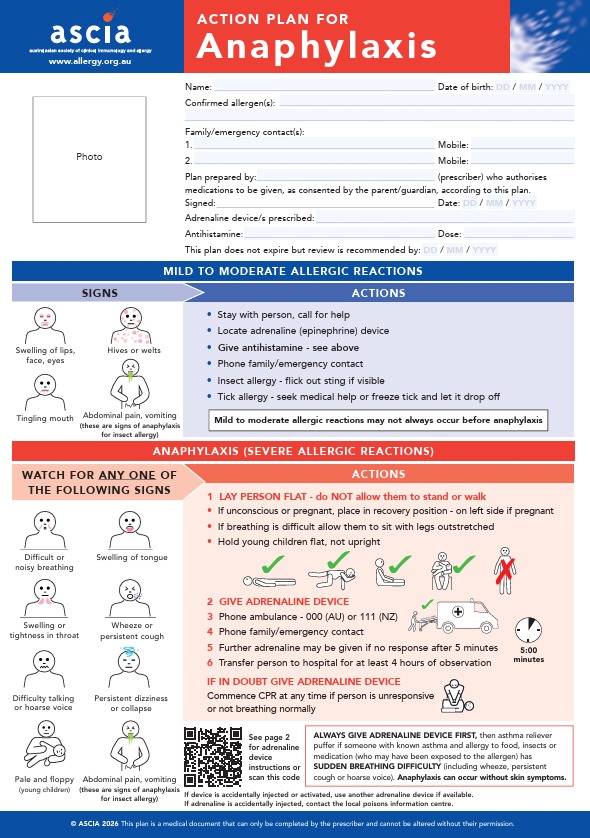
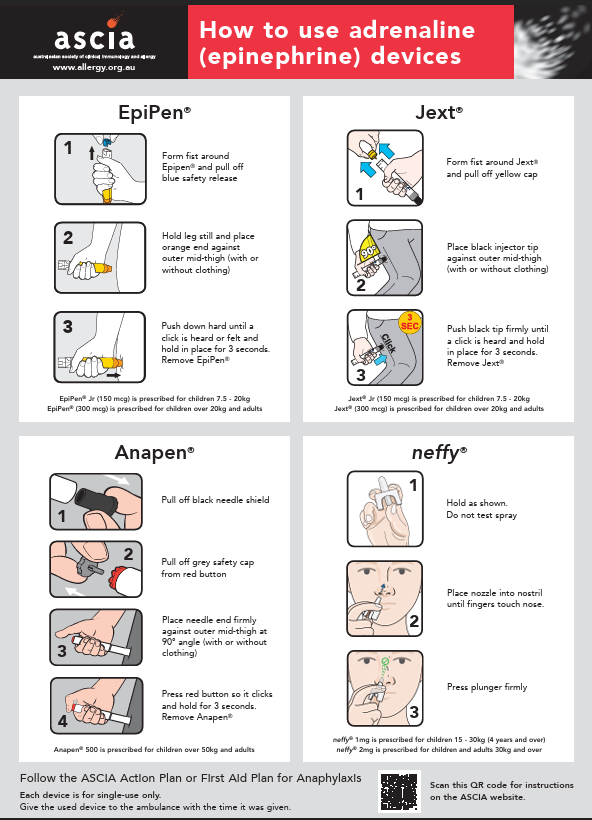
As part of our ongoing commitment to strong clinical governance and evidence-based practice, Medecs is providing an important update for disability, aged care, community, and health services regarding recently approved adrenaline devices that may now appear on individual ASCIA Action Plans for Anaphylaxis.
This update is designed to support organisational readiness, workforce confidence, and safe emergency response, and is guided by the Australasian Society of Clinical Immunology and Allergy (ASCIA), the recognised peak professional body for allergy and anaphylaxis management in Australia and New Zealand.
Two additional adrenaline devices neffy® and Jext® have now been approved for use in Australia by the Therapeutic Goods Administration (TGA). The introduction of a new adrenaline-based nasal spray has been described as the biggest change in the anaphylaxis space in more than two decades.
It represents Australia’s first needle-free option for the emergency treatment of severe allergic reactions and is intended to provide greater choice for individuals at risk of life-threatening anaphylaxis.
neffy® is a needle-free adrenaline nasal spray, while Jext® is a single-use adrenaline auto-injector. Both deliver adrenaline for the emergency treatment of anaphylaxis and may now appear on individual ASCIA Action Plans.
Both devices are:
neffy® is expected to be available from February as a Schedule 4 (prescription-only) medicine via private prescription, with an application for PBS listing submitted and consideration scheduled for March.
As with all adrenaline devices, prescribing decisions are made on an individual clinical basis.
All guidance in this update is informed by ASCIA, the authoritative, evidence-based peak body for allergy and anaphylaxis management in Australia. ASCIA:
ASCIA has updated its Action Plans to include device-specific versions referencing neffy® and Jext®, alongside established devices such as EpiPen® and Anapen®. This inclusion reflects regulatory approval, clinical evidence, and national consistency, not device familiarity or preference.
The inclusion of neffy® and Jext® on ASCIA Action Plans means:
Despite this significant development, the core principles of anaphylaxis management remain unchanged:
The delivery method may change. The emergency response framework does not.
Where a person supported by your service is prescribed a newer or less familiar adrenaline device, Medecs Learning recommends a measured, integrated approach:
This approach supports clinical safety, staff confidence, and policy alignment.
In line with our role as a clinical education leader, Medecs Learning has already introduced this change into our First Aid training programs. From March, assessment pathways will be expanded to include neffy®, once training devices are received, ensuring learners are:
As with all Medecs Learning programs, the focus remains on evidence-based decision-making, safe emergency response, and clinical confidence. This proactive integration ensures learners and services are prepared in advance, rather than reacting after change occurs.
For governance and leadership teams:
Strong clinical governance is demonstrated by calm, structured adaptation within evidence-based systems.
Services are encouraged to refer directly to ASCIA for primary source guidance:
As new medications and delivery methods emerge, ASCIA remains the definitive reference point for evidence-based anaphylaxis management in Australia.
Services that align their policies, training and emergency response systems with ASCIA Action Plans can be confident they are meeting contemporary best practice and supporting safe outcomes when it matters most.
If you have questions about how this information applies to your organisation, workforce or participant supports, speak with the Medecs clinical team.
Deb Stone R.N.
Managing Director
Clinical Governance Director