
NDIS medication training
medication competency assessment
support worker medication competency


Staff competency is the foundation of safe, person-centred high intensity support under the NDIS. Yet many organisations still only rely on informal check-ins, online training completion or outdated records to gauge whether their teams are ready for the clinical demands of complex care.
If you are responsible for workforce development at an NDIS-registered organisation, selecting the right assessment tool shapes audit readiness, participant safety, and team confidence. This guide walks you through the key factors to consider when evaluating NDIS high intensity support training and competency tools, with insights from Medecs Learning's experience training over 8,000 support workers annually across Australia.
A competency assessment tool is a structured method for measuring whether a support worker has the attitudes, skills, and knowledge required to deliver a specific type of care safely. In the NDIS context, these tools sit at the intersection of training delivery, clinical governance, and regulatory compliance.
The NDIS Quality and Safeguards Commission's Workforce Capability Framework describes the capabilities expected of all NDIS-funded workers, including supervisors. The framework establishes a shared language for "what good looks like," and a competency tool translates that language into observable, measurable evidence you can use on shift and during audits.
Good tools go beyond tick-box exercises. They combine knowledge checks, practical demonstrations, scenarios under clinical guidance, reflective practice prompts, and documented sign-off by a qualified Clinical Instrcutor.
High intensity daily personal activities carry elevated health risks for participants. Tasks such as complex bowel care, enteral feeding, tracheostomy management, and seizure care require precision. A single procedural error can lead to aspiration, infection, or a medical emergency.
For the people receiving these supports, the quality of every interaction matters. They deserve workers who are not only willing but truly competent, assessed against clear criteria, and supported to maintain their skills over time.
The NDIS Practice Standards require registered providers to use "appropriately trained and competent staff" who follow participant-specific care plans under clinical supervision. Without a reliable tool to verify competence, you have no auditable evidence that your team meets this standard.
There is also a workforce reality to consider. Staff turnover in the disability sector is significant. New team members join regularly, and participant needs change over time. A robust assessment tool helps you onboard workers faster, identify skill gaps early, and target training investment where it counts most.
The High Intensity Support Skills Descriptors published by the NDIS Commission outline the specific skills and knowledge your organisation should have access to when delivering complex supports. Each descriptor covers a particular support type, such as enteral feeding or urinary catheter care, and details the required scope, training, context, and interconnection with other descriptors.
When evaluating an assessment tool, ask whether it maps each skill descriptor to clear, observable criteria. A tool that treats "bowel care competency" as a single checkbox is too vague. You need criteria that address positioning, infection control, emergency response, and documentation separately.
The descriptors also specify that training must be delivered by an appropriately qualified health practitioner. Your assessment tool should record who conducted the training, what clinical scenarios were covered, and when reassessment is due.
Not all tools are built with the same rigour. Use the criteria below as a scorecard when comparing options for your organisation.
The tool should reference the relevant Practice Standards modules and High Intensity Support Skills Descriptors. If you deliver multiple support types, such as PEG feeding and diabetes care, the tool should cover each one with dedicated assessment criteria rather than generic checklists.
Written tests and e-learning quizzes confirm knowledge, but they do not prove a worker can perform a task safely on shift. Prioritise tools that require a qualified assessor to observe the worker demonstrating the procedure. According to the NDIS Commission's Training for Capability resources, observing a worker on more than one occasion gives a more reliable indication of typical practice.
Each participant's complex healthcare plan typically includes tailored instructions for communication, medication, nutrition, equipment usage, and emergency response. A strong assessment tool connects the competency check to the participant's specific plan rather than testing skills in isolation. This ensures the worker can apply their knowledge to the specific person they support.
Competence is not a one-time event. Skills can drift if a worker has not performed a particular procedure recently, or if care plan instructions have changed.
Look for tools that include built-in reassessment intervals, prompts for refresher sessions, and a way to track when each worker was last assessed against each skill descriptor.
Your tool should produce records you can present to auditors: who was assessed, what criteria were used, who assessed them, the date, the outcome, and any follow-up actions. Digital storage makes retrieval faster and reduces the risk of lost or incomplete paper records.
The NDIS Commission highlights that the supervisor or manager conducting the assessment must have "relevant skills, understanding and expertise." If your frontline supervisors lack clinical qualifications in a specific area, the tool should flag the need for an external clinician who specialises in the area of support.
Medecs addresses this by deploying clinical nurse educators to conduct competency assessments on-site or virtually. Your team is assessed by someone with direct clinical expertise in disability supports.
Choosing a competency tool is a decision that affects clinical governance, workforce planning, and compliance. Follow this process to keep the evaluation structured.
Start by listing every high intensity support your organisation delivers: enteral feeding, seizure management, stoma care, medication administration. Cross-reference each one with the matching High Intensity Support Skills Descriptor.
Then review your existing training records to identify where gaps exist. The NDIS Commission's Worker Capability Self-Assessment Tool is a useful starting point for this exercise.
Based on the factors above, create a shortlist of non-negotiable requirements. At a minimum, your criteria should include alignment to the relevant skills descriptors, a practical observation component, links to individual care plans, digital record-keeping, and a reassessment schedule.
Before committing, ask each tool vendor or training partner to walk you through a sample assessment for one of your common support types. Pay attention to how the tool handles edge cases, such as a worker who passes the knowledge check but needs further observation on the practical component.
Your clinical leads, whether internal registered nurses or external training partners, should review the tool's clinical rigour. They can verify whether the criteria reflect current evidence-based practice and whether the assessment method is appropriate for each procedure.
Roll out the tool with a small group of workers before organisation-wide adoption. Collect feedback on clarity, time required to complete assessments, and any areas where the criteria felt unclear or redundant.
Use pilot feedback to adjust the tool and the process. This smooths the rollout when you scale to the full workforce and helps your team see assessment as a supportive exercise, not an added burden.
Your competency records should connect to your broader workforce management processes, including onboarding checklists, supervision schedules, and incident response reviews. This integration helps you spot patterns, such as a correlation between unassessed workers and incident reports, and act on them quickly.
Supervision and assessment are closely linked. The NDIS Commission's Supervision for Capability resources recommend that capability assessment forms part of the regular performance management cycle. This means worker self-assessment combined with supervisor assessment, drawing on feedback and participant input to give a full picture.
A competency tool that includes a supervision module helps you schedule these conversations, record action items, and track whether follow-up training has been completed. This creates a feedback loop: assessment identifies a gap, supervision plans the response, training closes the gap, and reassessment confirms the outcome.
For high intensity supports, the stakes are higher. The skills descriptors advise that if time has elapsed since a worker last delivered a particular support type, or if procedures have changed, you should reassess their capabilities before they return to that role. Your tool should make this easy to track.
An assessment tool is only as good as the training it sits alongside. If the training itself lacks clinical depth or real-world application, even a well-designed assessment will not produce capable workers.
When choosing a clinical training partner, look for several qualities. Training should be designed and delivered by clinicians with direct experience in disability supports. The delivery format should include scenario-based learning, clinical manikins, or patient simulators for safe practice of high-risk procedures.
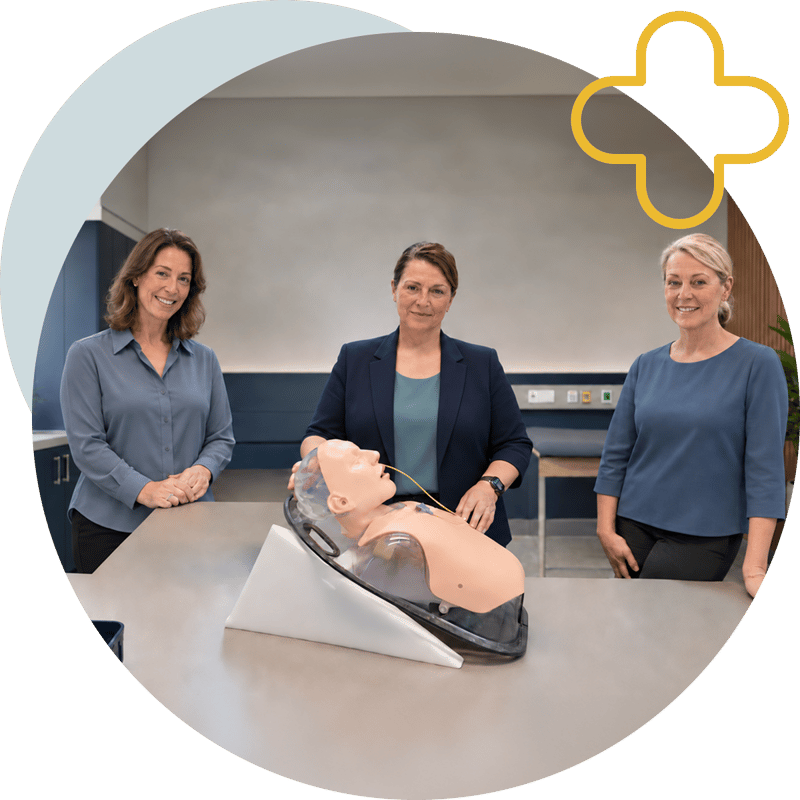
Medecs Learning uses clinical manikins and patient simulators alongside nurse-led video modules through its Online Academy. This gives your team hands-on exposure to real-world scenarios in a controlled environment before they apply those skills on shift.
Training aligned to each participant's individual care plan is also valuable. This means workers are not just learning a generic procedure; they are learning how to perform it for the specific person they support, with the specific equipment and emergency protocols that apply.
Avoiding these pitfalls will save you time and help protect participants.
A quiz can tell you what someone knows, but not what they can do. For high intensity supports, practical demonstration under clinical supervision is the gold standard. Written components should complement practical observation, not replace it.
Bowel care and enteral feeding involve different risks, equipment, and protocols. A tool with a single checklist for all high intensity supports is too broad to generate meaningful evidence. Each support type needs its own criteria, mapped to the relevant skills descriptor.
Initial assessment is a starting point. If you do not reassess regularly, you lose visibility into whether skills have been maintained, especially when staff move between participants or when care plans change. Build reassessment into your annual workforce calendar.
If the person conducting the clinical assessment does not have the clinical expertise for the support type being assessed, the results carry less weight. Make sure your assessors are qualified for each specific area, or partner with a training organisation that can supply qualified clinical assessors.
Medecs Learning trains over 8,000 support workers annually across Australia and partners with NDIS providers to build workforce capability that meets and exceeds the NDIS Practice Standards. The approach integrates training, assessment, and care plan development into a connected system.
Through complex healthcare services, Medecs Learning's clinical team develops or updates individualised care plans, delivers staff training aligned to those plans, and conducts competency assessments. This means your workers are assessed against the exact procedures and protocols they will use on shift, not a generic syllabus.
The Medecs Learning Online Academy adds flexible, self-paced learning that workers can complete between shifts. Nurse-led video modules cover each high intensity support area, from seizure management to medication administration. Providers can track team progress and identify who needs practical reassessment, all from a single platform.
Choosing a competency assessment tool is not a purchasing decision you make once and forget. It is a governance decision that shapes how confidently your team delivers high intensity supports, how prepared you are for audits, and how well you protect the people you support.
Start with the NDIS High Intensity Support Skills Descriptors as your benchmark. Compare every tool against the criteria covered in this guide: alignment to standards, practical observation, care plan integration, reassessment scheduling, audit-ready documentation, and qualified assessors. Pilot before you commit, and involve your clinical team from the start.
The right tool, paired with quality clinical training, turns competency from a paper exercise into a daily practice that keeps participants safe and your organisation compliant. If you are ready to explore how integrated training and assessment can strengthen your workforce, Medecs Learning's clinical team is here to help.
The NDIS Workforce Capability Framework describes the attitudes, skills, and knowledge expected of all NDIS-funded workers. It establishes a shared language for quality support and helps providers plan recruitment, training, and supervision. You can use it as the baseline when selecting any competency assessment tool.
Reassessment frequency depends on the support type, changes to care plans, and how recently the worker performed the task. The NDIS High Intensity Support Skills Descriptors recommend reassessment whenever procedures change or significant time has passed.
Building quarterly or six-monthly checks into your schedule is a practical starting point.
Online training builds foundational knowledge, but it cannot replace hands-on observation by a qualified clinician. Medecs combines online Academy modules with clinical practical assessment sessions so your team gains both knowledge and demonstrated skill, a combination that satisfies NDIS audit expectations.
The clinical assessor must have relevant clinical expertise for the specific support type being assessed. This typically means a registered nurse, allied health professional, or other qualified health practitioner.
If your organisation does not have in-house clinical staff, partnering with a clinical services provider like Medecs gives you access to experienced clinical nurse educators who conduct assessments on-site or virtually.
A gap identified during assessment is an opportunity, not a failure. The worker should receive targeted follow-up training, additional supervised practice, and a scheduled reassessment.
Medecs builds this feedback loop into its training programs, connecting assessment outcomes to refresher sessions and care plan reviews so workers reach competence with encouragement rather than pressure.
If you have questions about how this information applies to your organisation, workforce or participant supports, speak with the Medecs clinical team.